Picture your setup. The office is here. You've got a bin site twenty miles one way, another five miles the other way, maybe a shop and a few outbuildings in between. When the augers are running and trucks are rolling, you can't be in three places at once — but you need to know what's happening at all of them. Running fiber or cable across that many miles of section ground isn't realistic. So most folks just drive out and check, or fly blind.
There's a better way, and it's something we do a lot of out here: a point-to-point wireless link.
What a point-to-point link actually is
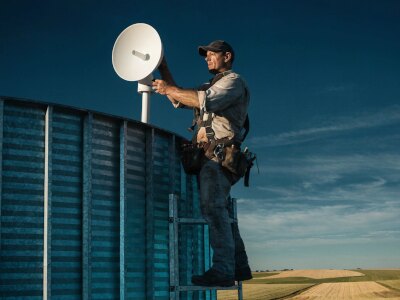
A point-to-point link is a pair of small directional antennas — one at the office, one at the bin site — aimed straight at each other across the open country. With a clear line of sight, a single link reliably carries a connection several miles, and with the right gear it'll reach the far corners of a big operation. We build these with professional-grade equipment like Ubiquiti and MikroTik, the same hardware that carries serious data loads — we're talking hundreds of megabits up to a gigabit on a good link, plenty for cameras, controls, and internet all at once.
No trenching. No cable strung across a mile of wheat. Just a clean radio shot from point A to point B.
One link, three jobs
Here's what makes this worth doing: that single link does three things at the same time.
1. Eyes on every site — cameras
Put cameras at the bin site — on the augers, the driveway, the fuel tank, the gate — and their video rides the link back to your office. From one screen (or your phone) you watch the twenty-mile bins and the five-mile bins like they're in the next room. See the truck pull in. Watch the auger run. Check the yard at 2 a.m. without leaving the house. No monthly per-camera fee, no cloud subscription — it's your network, carrying your cameras.
2. Hands on every site — automation
This is where it gets powerful. Because the link is a real network connection, it doesn't just carry pictures — it carries control. We tie your automation into the same link, so from the office you can start and stop equipment remotely: kick on the auger or the leg that runs grain up into the bin, switch fans and aeration on or off, run the dryer, open a gate. You sit in your chair, you see it on camera, and you control it — miles away. Combined with our cameras, you're not guessing; you watch the bin fill and shut it down at the right moment without driving out.
3. Internet out at the bins
The same link that carries your cameras and controls also carries internet to the bin site. Your office connection rides out to the remote location, so the bins, the shop, the scale — whatever's out there — get online through the link. One connection at the office becomes connectivity across the whole operation. That means grain-bin monitors, moisture sensors, and any smart equipment out there can phone home too.
Why this beats the alternatives
You could put a separate cellular plan or a satellite dish at every site — and pay a monthly bill for each one, forever, with data caps and weather hiccups. A point-to-point link is gear you own. We install it once, it carries everything, and there's no recurring per-site fee for the link itself. For an operation spread across miles of southwest Kansas, that math adds up fast.
What it takes
The main requirement is line of sight — a clear shot between the antennas. Around here, mounting one end up on a grain bin, a pole, or a tower usually gives us the height we need to clear the terrain. We come out, survey the path between your sites, figure out where the antennas go, and design a link that holds up in Kansas wind and weather. Then we wire your cameras and automation into it and set you up to see and run it all from one place.
If your operation is spread out and you're tired of driving to check on bins you can't see, this is exactly what we build. Let's map out your sites and put your whole place on one screen.